
15 November 2025
Fabrics as Reinforcement Materials in Composite Materials
A composite material consists, as the name suggests, of a combination of different – but at least two – base materials. In addition to the resin matrix, reinforcement is an important component of composite materials. The resin matrix serves to embed and support the fabric and primarily performs two tasks: transferring mechanical loads to the fibers and protecting the reinforcement from external environmental influences, such as chemicals. Epoxy resins, phenolic resins, silicone resins, and melamine resins are mainly used for composite materials. Besides the resin systems, the fibers used play a decisive role in the properties of composites. Fibers are twisted, spun, or laid into yarns, and these yarns are then woven into fabrics, which reinforce the composites. This brief introduction to fabrics as reinforcement materials in composites will progress from the small fiber to the larger yarn and finally to the fabric.
Fibers as Building Blocks of Yarns
Glass Fibers
Glass fibers are inexpensive to produce and mechanically very stable. This combination makes glass fibers the most widely used fibers for composites. Only in applications where extreme lightweight requirements exist, such as aerospace, are lighter fibers like carbon fibers preferred. Glass fibers are classified into E-glass and S-glass. The 'E' in E-glass stands for 'electric.' These fibers are mainly used for composites in electrical insulation and account for 90% of the glass fiber market. The 'S' in S-glass stands for 'strength.' These fibers have increased strength due to a different composition. Other types include acid-resistant EGR, temperature- and moisture-resistant R-glass, and Q-glass for very high temperatures, though these are niche products.
Carbon Fibers
Carbon fibers have excellent mechanical properties at very low weight and density. However, they are much more expensive than glass fibers. Therefore, carbon fibers are only used where extremely low density is required, such as aerospace, high-performance automotive applications, motorsports, and increasingly in consumer sports equipment like racing and mountain bikes. Carbon fibers are categorized by properties such as strength, stiffness, and modulus of elasticity.
Aramid Fibers
Aramid is a portmanteau of 'aromatic polyamide.' It is a polymer and thus technically a synthetic fiber. Aramid fibers are particularly important in ballistic composites because they have extremely high elongation at break, allowing them to absorb a lot of energy. This improves ballistic performance, as composites based on aramid fibers can absorb the kinetic energy of projectiles and stop them.
Synthetic Fibers
Other synthetic fibers used as reinforcement in composites include polyester, polyamide, and polyethylene. Their different properties create composites for a wide range of applications.
Natural Fibers
The most important natural fibers used in composites are cellulose and cotton. Cellulose, obtained from trees, cannot be spun into yarn and is used in paper form with random fiber orientation. Cotton fibers, however, can be spun into yarn and woven into fabrics. Natural fibers have low density but are far less mechanically stable than glass or carbon fibers. Cotton fibers have a low friction coefficient, making cotton-based composites suitable for sliding bearings, guide rails, and ball bearing cages.
Yarns
Yarns are defined by DIN 60900 as a 'generic term for linear textile structures' – a long, thin assembly of multiple fibers. This intermediate product forms the basis of every fabric. Two yarn types are distinguished: staple fiber yarns, made of finite-length fibers twisted together and held mainly by friction, and filament yarns, made of continuous fibers that can simply lie side by side without twisting. Natural fibers cannot form filament yarns because they are always of limited length.
Sizing
For further processing, a coating called sizing is applied to the yarn surface. This smooths the yarn and makes it more resistant, enabling it to withstand mechanical forces during weaving without failure. Normally, sizing is removed after weaving by washing, acids, sulfates, thermal, or enzymatic processes (desizing). Sometimes, sizing is left on as an adhesion promoter between resin and yarn, in which case it must match the resin type (e.g., silane sizing for epoxy).
Fabrics
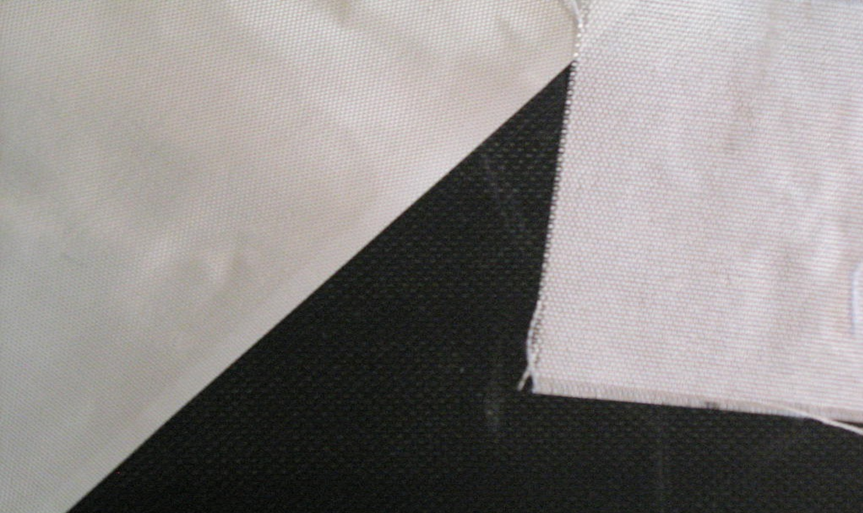
A textile fabric consists of threads from two directions interlaced to form a stable structure, usually crossing at approximately 90°. The longitudinal threads are called warp, and the transverse threads are called weft. The connection relies mainly on friction, so fabrics must be tightly woven for sufficient shear strength. Today, fabrics are industrially produced on mechanical looms. Technical fabrics for composites are best categorized by weave pattern.
Roving
Roving refers to a multifilament yarn made of many continuous fibers lying loosely side by side. Rovings are not twisted, though slight twists (less than 10 turns per meter) may be used for stabilization. Rovings are only made from synthetic fibers like glass, carbon, and aramid. They are characterized by filament count and fineness (e.g., 3K = 3000 filaments per yarn, 800 tex = 800 g per 1000 m).
Plain Weave
The simplest weave is the plain weave, where warp and weft alternate regularly. It is suitable for flat laminates but poorly drapable. Drapability determines how well a fabric can conform to curved shapes without wrinkling, essential for 3D composite parts made by processes like resin transfer molding (RTM).
Twill
Twill weave has the weft passing over one warp and under two or more warps, shifting by one warp in each row, creating a diagonal pattern called a 'rib.' Twill is more drapable and also suitable for stiff laminates.
Satin
Satin weave creates an uneven front and back, with the weft passing over one and under several warps. It is also drapable and forms stiff laminates.
Unidirectional
Not a true fabric, unidirectional refers to yarns laid in one direction, maximizing fiber volume and mechanical properties in that direction. The material is highly anisotropic. The yarns are lightly fixed with small transverse threads.
Mock Twist
This weave uses alternating threads that twist over and under each other, making it highly drapable and suitable for thick laminates.
Roving Fabrics
Any fabric based on roving yarns is called roving fabric. Common weaves include plain and twill, with satin also possible. Unidirectional layouts are frequent for maximum reinforcement in one direction. Complex weaves like mock twist are rarely used industrially.
Conclusion
Fibers form the foundation of many composite materials. They appear as fibers, yarns, or fabrics, but always play a key role in improving mechanical properties. Without the excellent properties of various natural and synthetic fibers, modern composites would not exist in their current form.